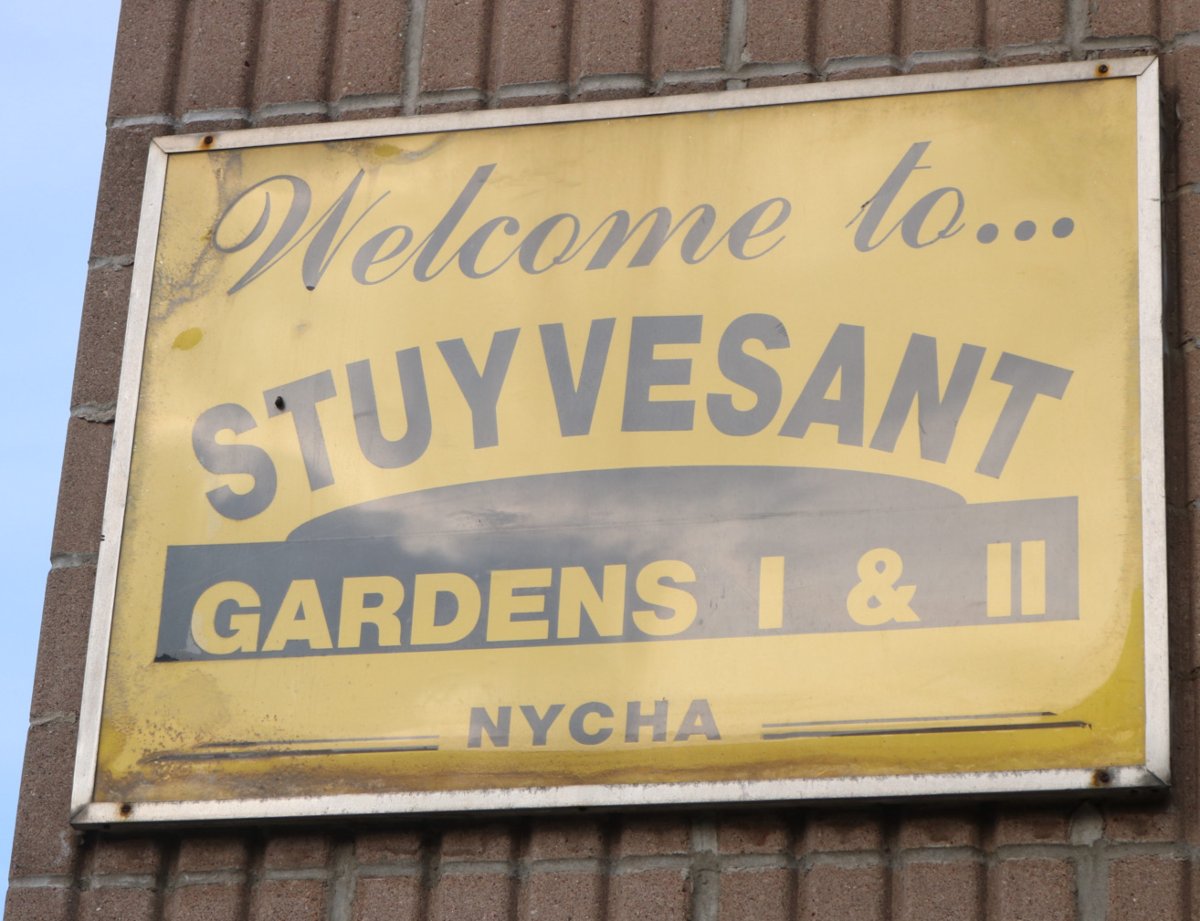
Stuyvesant Gardens Houses are located in Brooklyn’s Bedford-Stuyvesant neighborhood, bordered by Gates Ave, Malcolm X Boulevard, and Monroe Street. Built in 1972, Stuyvesant Gardens Houses were among the first NYCHA developments constructed after World War II as part of the city’s effort to provide quality housing for working-class residents.
The complex is divided into two sections—Stuyvesant Gardens I and II—and consists of 11 apartment buildings housing more than 1,100 residents.
Rather than high-rise towers, Stuyvesant Gardens is composed of low- and mid-rise brick buildings arranged around open green courtyards, reflecting early public housing ideals that emphasized light, air, and access to shared outdoor space.
Despite its thoughtful design and community-oriented origins, the complex has failed nearly as spectacularly as it stands. Stuyvesant Gardens has not been immune to the challenges facing many NYCHA developments in the rest of the city.
Over time, the complex has faced deteriorating conditions, delayed repairs, and budget constraints that have periodically undermined residents’ quality of life. Crime and safety concerns have also surfaced at various points in its history.
Its residents have continued to fight to preserve the complex’s history, identity, and role within the neighborhood. Stuyvesant Gardens remains deeply woven into the fabric of Bed-Stuy, with residents building informal networks of care, support, and mutual responsibility.
Over generations, Stuyvesant Gardens has been home to Brooklynites who helped shape the culture, resilience, and character of the surrounding neighborhood. Less imposing than some of NYCHA’s larger developments, Stuyvesant Gardens is notable as part of the first postwar housing boom that helped define modern Brooklyn.
In 2025, the complex was nominated for inclusion in the State and National Registers of Historic Places, highlighting the site’s significance as a product of community advocacy and urban planning under the federal Model Cities program, according to a press release.
Ultimately, the complex stands as an ode to Bed-Stuy’s enduring spirit—a community still fighting for dignity, heritage, justice, and stability.